Wait, Who's Paying for That Loft? The Great Sitcom Rent Scam Nobody Talks About
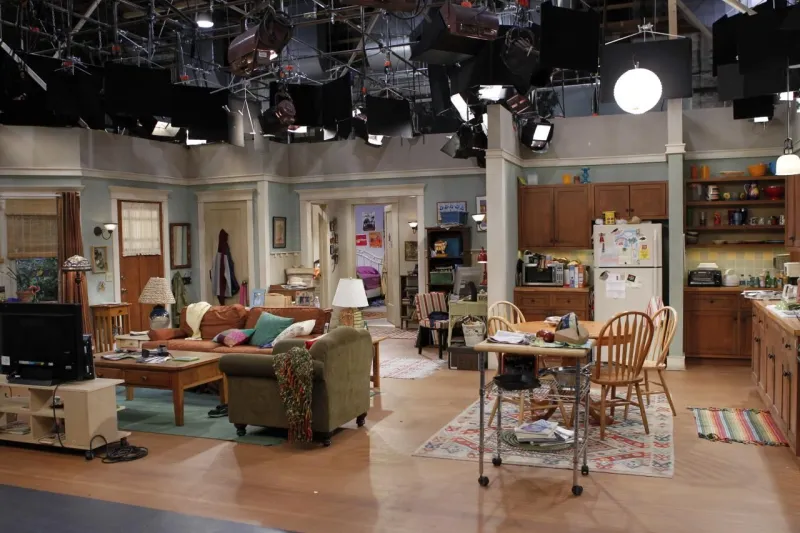
Photo: cozy sitcom-style apartment living room set with couch and kitchen, via i.pinimg.com
There's a special kind of rage that only hits when you're an adult with a real paycheck watching a fictional 24-year-old pour lattes four hours a week from a sun-drenched two-bedroom in Greenwich Village. If you know, you know. And if you don't know, you either bought a house young or you're still living with your parents. No judgment. Okay, some judgment.
We're calling it the fake apartment tax — the unspoken subsidy every sitcom character receives from the universe so their life can look like that. And now that streaming has made it easier than ever to binge old favorites, a whole corner of the internet has decided to do the math. Spoiler: the math does not math.
The Barista Who Beat the Housing Market
Let's start with the most famous offender of all time. One coffee-shop waitress in a certain legendary Manhattan apartment has been the subject of more rent discourse than any fictional human alive. Fans have estimated her building's real-world equivalent would run somewhere north of $4,500 a month in today's market. Her income? Coffee, tips, and the occasional paycheck from a coffee shop she apparently didn't show up to for whole seasons.
One Reddit user who's been tracking this for years — we'll call him Dave, because that's his username and we respect the commitment — put it plainly: "I've lived in New York. I had three roommates and a mattress on the floor. She had a full apartment with a balcony. A balcony. I've made peace with a lot of TV nonsense. Not that. Never that."
The show eventually addressed it with a rent-control retcon, which is the sitcom equivalent of your uncle explaining crypto at Thanksgiving: technically a sentence got said, and nobody is convinced.
The Job-to-Apartment Ratio Is Broken Everywhere
Once you start looking, you can't stop. The fake apartment tax isn't a New York problem — it's a genre problem.
Consider the greatest hits:
- The Chicago radio producer with a lakefront-adjacent apartment that would cost a real person roughly 40% of a producer's actual salary. Before taxes. Before the hats.
- The Miami crime-fighter whose pastel art deco apartment, boat maintenance, and tailored wardrobe somehow coexisted with a salary best described as "occasionally a detective."
- The Seattle radio psychiatrist whose converted radio-station loft in one of the most expensive zip codes in the country was bankrolled by a talk show that, by all on-screen evidence, aired at 2 a.m.
- The small-town pastry enthusiast whose kitchen alone was bigger than the median American bedroom, in a town where her main customer base appeared to be six people.
There's a formula forming here. Take a charmingly modest job, add a metropolitan setting, and multiply the square footage by whatever the plot requires. Economists would call this a market failure. Sitcom writers call it Tuesday.
Why We Keep Letting It Slide
Here's the thing — nobody actually wants realism in this one specific department. A show about a waitress with three roommates in a walk-up with roaches is called a drama, and it's very good, and it won awards, but it is not a comfort watch. The fake apartment tax is essentially the price of admission for coziness. It's aspirational wallpaper.
Streaming has changed the relationship, though. Back in the network era, you watched an impossible apartment once a week and didn't think about it. Now, when a show sits in your queue for a decade, you rewatch it as an adult with a mortgage and a utility bill, and suddenly you're pausing episodes to count windows. The rent discourse is a direct product of the rewatch economy. Shows used to get a pass because we were young and dumb. Now we're older and we have Zillow.
The Fans Who Can't Stop Doing the Math
The most delightful part of all this is how sincere the number-crunchers are. TikTok is full of creators doing full cost-of-living breakdowns for fictional characters, complete with era-appropriate salary data and inflation adjustments. One creator estimated that a certain group of six friends' combined rent, adjusted for Manhattan pricing, would require roughly triple their combined stated income. Another did a full spreadsheet for a certain cartoon sponge who supports himself on fast-food wages in an underwater pineapple — which, honestly, might be the most affordable setup on this list.
And look, we get it. There's something weirdly comforting about knowing the fantasy is a fantasy. The characters can't afford their lives, we can't afford our lives, and for twenty-two minutes nobody has to say the word "inflation."
A Modest Proposal
If shows want to keep the fantasy, fine. But we'd like one honest sitcom. One character with a realistic studio, a roommate situation that's clearly codependent, and a visible wince every time the electric bill arrives. Just one. It would be the most relatable thing on television.
Until then, pour one out for every fictional waitress with a balcony. They're living in a world where the landlord is the writer's room — and honestly, that's the best deal in America.